
Board of Education Action Meeting: August 17, 2023
by Lisa Haver and Deborah Grill
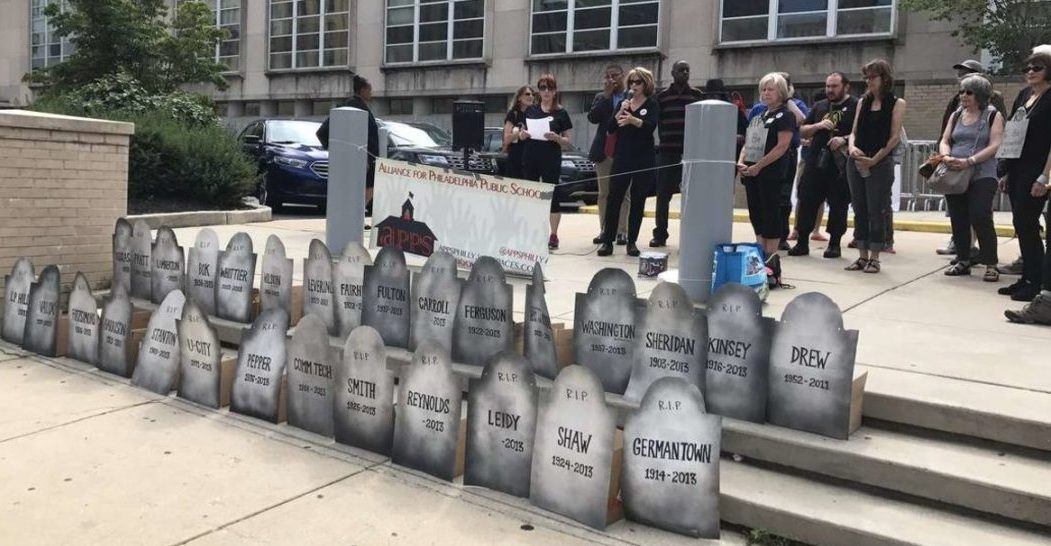
APPS members scored a significant victory in its fight against the Board of Education’s speaker suppression policies. APPS, joined by the student advocates of UrbEd, filed suit against the board in 2021 after it capped the number of speakers at board meetings and cut speaker time from 3 minutes to 2. The case was heard in court earlier this year, and the judge issued a split decision earlier this month. The judge agreed with the position of APPS and UrbEd that the board should keep a waiting list for those who signed up to speak but didn’t make it onto their limited list of 30. Board President Reginald Streater announced that in keeping with the judge’s ruling, the board would allow anyone attending in person to sign up to speak; in the event that one or more speakers did not show, they would be called up. One community member did sign up at the meeting and was able to testify in favor of the community garden at Steel Elementary School.
In another victory for APPS members and the community, the Board of Education announced that it would no longer be spending two hours of every monthly action meeting to analyze the data collected that month in its Goals and Guardrails program. APPS members had asked the board several times–in meetings, in letters and in testimony–to conduct the G & G analysis in a separate venue. Last year, we lobbied the board to place public speakers before the G & G; the board finally relented. The board still needs to hear from speakers earlier in the meeting: in both June and August meetings, speakers were not called up until 9 PM. And even without the G & G, neither meeting adjourned until 11 pm.
APPS Members Urge Board to Deny KOZs, Revoke Franklin Towne Charter
The board hears student speakers early in the meeting, even before Superintendent Watlington gives his remarks. They should hear from general speakers at that time also. Parents and community members should not have to wait five hours to be heard, as they did at this meeting and the June meeting. Those at the end of the list may not be called up after 10 PM. One community member who testified virtually said she had waited over 6 hours. This is a serious barrier to public speaking.
Deborah Grill urged the board not to renew Philadelphia Academy Charter in light of their history of corruption and conflicts of interest. She also urged the board to move forward with the revocation of Franklin Towne. Barbara Dowdall alluded to the recent controversy at the Girls High graduation where one student’s diploma was withheld because of her behavior on stage. President Streater was quoted in news stories saying we should not deprive students of the celebrations of “joy”. Dowdall pointed out that restoring libraries with Certified Teacher librarians would create moments of joy for students every day. Ilene Poses made a strong case for denying Keystone Opportunity Zone (KOZ) tax abatement extensions, ending with her singing that rich developers “pay your taxes, too”. Lisa Haver also urged the board to revoke Franklin Towne High’s charter. She told of working at Harding Middle School in East Frankford over ten years ago and seeing white graduating 8th graders on their way to Franklin Towne and Black graduates going to Frankford High School. The discrimination was obvious even then, said Haver. Teacher Kristin Luebbert asked why Penn and Drexel, who own some of the parcels eligible for KOZ extensions, need another tax abatement, saying, “It is beyond outrageous that you are considering yet another tax break for properties owned by Penn–an institution that hoards its 20 billion dollar endowment while charging high tuition and dodging taxes and PILOTS.”
Board Approves Tax Break Extensions for Developers
The board first posted only the titles of the five KOZ items on the agenda with a “pending” notation. Two days before the meeting they filled in the content–not with any meaningful explanation, but with paragraphs of legal jargon. Missing were: the names of the owners of the properties, an explanation of how the KOZ abatement program works, why the property owners in question deserved an extension (or a second or third extension), and how they would benefit the district’s students and families. The board agenda included a presentation from three representatives from the City Commerce Department. The purpose of the KOZ program, in their words, is to” spur development” in blighted areas. Some may agree that it makes sense to offer developers a 100% tax abatement for five years so that they can build businesses on the parcels and hire permanent employees who would then contribute to the city’s tax coffers through the wage tax; the property owners would pay real estate tax after the building was completed. But why would the owners and developers need or deserve an extension on the abatement if they hadn’t begun to build? Board members asked incisive and challenging questions. They pointed out that many of these properties were no longer in blighted areas. The City representatives answered, unironically, that the developers’ failure to build in itself made the still empty lot a blighted area. But even after the City’s failure to justify the extensions, the board voted to approve four of the five KOZ extensions. The board voted against the extension for the Frankford Arsenal property by a vote of 3-6. The consensus was that the owners did not deserve yet another extension after leaving the parcel undeveloped for almost 30 years.
Board Votes to Begin Revocation of Franklin Towne Charter High School
Charter Schools Office Acting Director Peng Chao presented evidence on the Franklin Towne Charter High School’s rigging of their enrollment for the purpose of keeping Black and brown children from attending. News of the administration’s outright racial discrimination, reported in the Philadelphia Inquirer, was shocking but not surprising for those following Franklin Towne charters, including APPS members who have done extensive research on the school and its investors. Franklin Towne Charter’s documented corruption began long before the most recent scandal. In 2016, the Philadelphia Inquirer reported that FTC”s principal had filed suit against the school for wrongful termination after he told the school’s board chair that the school was billing the district for full-day kindergarten that was actually half-day, that the charter was “awash in nepotism”, and that the school had hired the wife of a former board member for a nonexistent job. Earlier this year, the school’s longtime Chief Academic Officer blew the whistle on the rigging of the school’s enrollment lottery for the express purpose of keeping out Black and brown students. Franklin Towne charter administrators who testified at this meeting, along with some of the board members, contended that the people who perpetrated the cheating were gone and that it wouldn’t be fair to punish the students by closing the school. They implied that no one other than a few bad apples knew what was going on, but Board Member Julia Danzy asked whether the people at Franklin Towne ever looked around and asked, What is going on here? Franklin Towne administrators, through their actions, have hurt the school’s students and families, not the board of education. Over the past twelve years, the district twice renewed Franklin Towne High’s charter with the condition that the school adjust its enrollment process to admit more students of color. The school’s administrators agreed to the conditions, but apparently had no intention of honoring them. The district gave FTC several chances to fix its racial imbalance. They did the opposite. Franklin Towne’s deliberate racial discrimination put their school in jeopardy. They must accept the consequences. For over 20 years, charter investors have sold their schools as a better alternative to public schools. They promised to educate the same children that the district does, only better. Charter schools do not have an absolute right to exist. When they are given several warnings that they ignore, when their actions harm the children of the district, their charter should be revoked. The board voted 8-1 to proceed with the revocation, with BM Cecelia Thompson dissenting.
The board also voted to renew six charter schools.
President Streater reminded those in attendance of the Policy Committee meeting next Thursday, August 24 at 4 pm.
The board approved spending of approximately $42, 584, 892 at this meeting. That does not include the cost of the six 5-year charter renewals or the loss of income due to the four approved abatements.
The meeting adjourned at 11 PM.
 Alliance for Philadelphia Public Schools